Picea abies (Norway Spruce)

Norway Spruce


Price £ each (ex VAT)

Height Age 25+ 100+ 500+
40-60cm 2+1 0.93 0.56 0.51

Delivery

Bareroot from November to April

Prices

The prices above are offered as a guide and may be subject to fluctuation dependant upon the time of season and supply. We recommend that contact is made with the office for larger orders, a quotation and to check availability Alternatively please contact us to enquire about opening a wholesale account.

Also more familiar as the Christmas tree sold in its thousands in December, the Norway Spruce is native to northern Europe. Fast growing, it is widely grown commercially, not only as a Christmas crop, but for its timber which is used in the construction industry and for wood pulp. It has an attractive pyramidal shape when young, gradually becoming more columnar with age. It bears numerous large slender cones.

Site and soil

Does best in moist soils – it will even tolerate waterlogged soil. Copes well with exposed sites, shade and acid soil.

Height and spread

After 10 years: 8m x 3m
After 20 years: 15m x 4m

Leaf and bark

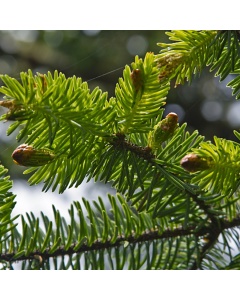
The leaves are stiff pointed 4-sided needles about 2.5cm long. They are dark green. The bark is reddish brown, becoming darker with age, with peeling scales. The young shoots are orange-brown.

Flower, seed and fruit

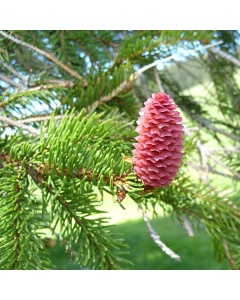
The flowers appear in May, the female flowers are pink, held upright on the branches, but gradually turning downwards as the cones develop. The cones ripen to a shiny reddish-brown, up to 20cm long.

Uses

Commercial forestry, Christmas tree crop, woodland, large gardens, shelterbelts. Grown as a nurse tree for slower-growing species. The timber is white and is known as deal, often used for kitchen tables. It is used in the construction industry, for making musical instruments and for wood pulp. A herbal tea has been made from the leaves and turpentine is extracted from the resin.

Wildlife

Various birds are attracted to the Norway Spruce for nesting and feeding, including the Crossbill and the Siskin. Many insects, including the Gypsy Moth and the Scalloped Hazel Moth feed on the tree.

Pruning

The Norway Spruce is not normally pruned.